Navigating Late Filing Penalties: Your Guide to GST Compliance in India
The Goods and Services Tax (GST) regime, a cornerstone of India’s indirect tax system, streamlines countless business operations. However, navigating its intricacies, especially regarding timely compliance, can be a challenge for many Indian businesses. A common pitfall that often leads to significant financial implications for businesses, large and small, is the issue of late filing penalties. Understanding these penalties is not just about avoiding fines; it’s about safeguarding your business’s financial health and maintaining a strong compliance record. This comprehensive guide will delve deep into the world of GST penalties India, specifically focusing on the repercussions of delayed GST return filing, offering practical insights, and demonstrating how a robust platform like MGH Books can be your shield against such avoidable costs.The Criticality of Timely GST Return Filing in India
Timely GST return filing is more than just a procedural formality; it is the backbone of a healthy and compliant business operation in India. The GST framework is designed to ensure a smooth flow of input tax credit (ITC) and transparent tax collection, both of which hinge on businesses submitting their returns by the prescribed due dates. Any deviation from these deadlines can trigger a cascade of negative consequences, impacting not only the defaulting business but also its entire supply chain.Why Due Dates Matter: A Foundation for Compliance
The GST law, specifically the Central Goods and Services Tax (CGST) Act, 2017, along with the State Goods and Services Tax (SGST) Acts and the Integrated Goods and Services Tax (IGST) Act, mandates specific due dates for various returns. For instance, GSTR-1 (statement of outward supplies) is typically filed monthly or quarterly, while GSTR-3B (summary return of outward and inward supplies, and payment of tax) is filed monthly. These dates are not arbitrary; they are crucial for:- Seamless ITC Flow: Your customers or recipients can only claim ITC on supplies you’ve declared in your GSTR-1. A delay on your part directly impacts their ability to claim ITC, potentially leading to disputes and strained business relationships.
- Government Revenue Collection: Timely filing ensures that the government receives its due tax revenue on schedule, funding public services and infrastructure.
- Maintaining Business Credibility: A consistent record of timely compliance enhances your business’s reputation and financial trustworthiness with suppliers, customers, and financial institutions.
- Avoiding Penalties: The most direct consequence, as we will explore, is the imposition of late fees and interest, directly impacting your bottom line.
Understanding the GST Return Ecosystem
The GST ecosystem is interconnected. Your GSTR-1 feeds into the GSTR-2A/2B of your recipients. Your GSTR-3B summarises your overall tax liability and ITC claims. Other returns like GSTR-9 (Annual Return) and GSTR-9C (Reconciliation Statement) provide an annual overview. A delay in filing even one return can disrupt this entire chain. For example, if you delay GSTR-1, your buyer cannot see the ITC in their GSTR-2B, leading to potential cash flow issues for them. This interdependence highlights why a holistic approach to GST compliance is essential, moving beyond just individual return filing to understanding the system as a whole. For a detailed guide on filing specific returns, you can refer to resources like How to file GSTR-1, step by step (2026).The Ripple Effect of Delay: Beyond Just Penalties
While monetary penalties are the most immediate and visible consequence of late filing, the ripple effect extends far beyond.- Impact on Cash Flow: Paying late fees and interest means diverting funds that could otherwise be used for business operations, investments, or expansion.
- Loss of Business Opportunities: Some government tenders or large corporate contracts may require a clean GST compliance record. Repeated delays could disqualify your business.
- Increased Scrutiny: Businesses with a history of late filing are more likely to attract scrutiny from GST authorities, potentially leading to audits and more detailed investigations.
- Difficulty in Obtaining Loans: Financial institutions often review a business’s compliance history, including GST filings, when assessing loan applications. A poor record can hinder access to credit.
- Supply Chain Disruptions: As mentioned, delayed GSTR-1 can affect your buyers’ ITC claims, potentially leading them to seek more compliant suppliers.
Deciphering Late Filing Penalties for GST Returns
When it comes to GST penalties India, late filing fees and interest are the most common and often misunderstood aspects. The CGST Act, 2017, along with corresponding SGST Acts, clearly outlines these charges. It’s crucial for every business owner, accountant, and CA to have a precise understanding of how these penalties are calculated and applied to avoid unpleasant surprises.Specific Penalties for GSTR-1 and GSTR-3B
The late fee structure for GSTR-1 and GSTR-3B has seen revisions over time, aiming to provide relief to smaller taxpayers while maintaining compliance discipline.GSTR-1 Late Fees (Section 47 of CGST Act)
As per Section 47 of the CGST Act, a late fee is levied for delayed filing of GSTR-1. The current structure, as last updated by various notifications, is as follows:
- For taxpayers with NIL outward supplies: ₹50 per day (₹25 CGST + ₹25 SGST) for each return, subject to a maximum of ₹500 (₹250 CGST + ₹250 SGST).
- For other taxpayers (having outward supplies): ₹50 per day (₹25 CGST + ₹25 SGST) for each return, subject to a maximum of ₹5,000 (₹2,500 CGST + ₹2,500 SGST).
It’s important to note that these maximum caps have been subject to changes via various notifications by the GST Council. For instance, during the initial phases of GST implementation and during the COVID-19 pandemic, these caps were often reduced for specific periods to provide relief. However, the standard limits mentioned above are generally applicable.
GSTR-3B Late Fees (Section 47 of CGST Act)
The late fee for GSTR-3B is similar to GSTR-1 but often has specific provisions for different turnover categories.
- For taxpayers with NIL tax liability: ₹50 per day (₹25 CGST + ₹25 SGST) for each return, subject to a maximum of ₹500 (₹250 CGST + ₹250 SGST).
- For taxpayers with turnover up to ₹1.5 crore: ₹50 per day (₹25 CGST + ₹25 SGST), subject to a maximum of ₹2,000 (₹1,000 CGST + ₹1,000 SGST).
- For taxpayers with turnover between ₹1.5 crore and ₹5 crore: ₹50 per day (₹25 CGST + ₹25 SGST), subject to a maximum of ₹5,000 (₹2,500 CGST + ₹2,500 SGST).
- For taxpayers with turnover above ₹5 crore: ₹50 per day (₹25 CGST + ₹25 SGST), subject to a maximum of ₹10,000 (₹5,000 CGST + ₹5,000 SGST).
These caps and daily fees are crucial to understand. The late fee is calculated per day from the due date until the actual filing date. This can quickly accumulate, especially for businesses that delay filing by several weeks or months.
Interest on Delayed Tax Payments: The 18% Gauntlet
Beyond late fees, a more substantial financial burden for businesses with tax liability is the interest levied on delayed tax payments. Section 50 of the CGST Act, 2017, mandates interest at the rate of 18% per annum on the net tax liability (after adjusting ITC) for the period of delay.How Interest is Calculated:
Interest is calculated from the day immediately following the due date of payment until the date of actual payment. This applies to any amount of tax not paid or paid late. The calculation is straightforward:
Interest = (Tax Payable * 18% * Number of Days Delay) / 365
Unlike late fees, there is no maximum cap on interest. The longer the delay, the higher the interest amount. This 18% rate is significant and can quickly erode a business’s profits, especially for large tax liabilities. It’s a key reason why businesses should prioritize timely tax payment, even if they anticipate a slight delay in filing the return itself (though filing the return is also crucial).
Maximum Late Fees: A Cap, But Still Costly
While the late fees for GSTR-1 and GSTR-3B have maximum caps, as detailed above, these caps apply per return. If a business consistently delays filing multiple returns over several months, the cumulative late fees can still be substantial. For example, a business with a turnover above ₹5 crore that delays GSTR-3B filing by 30 days for three consecutive months could incur ₹30,000 in late fees (₹10,000 x 3 months), in addition to 18% interest on any delayed tax payments.Practical Scenarios and Financial Impact of GST Penalties
Understanding the theoretical framework of GST penalties India is one thing; grasping their real-world financial impact is another. Let’s explore some practical scenarios to illustrate how late fees and interest can quickly add up, affecting businesses of different sizes and circumstances.Case Studies: Small Business vs. Large Enterprise Delays
Scenario 1: A Small Trader (Turnover below ₹1.5 Crore)
XYZ Traders, with an annual turnover of ₹1 crore, usually files GSTR-3B by the 20th of the subsequent month. For the month of October, due to an oversight, they filed their GSTR-3B on November 30th instead of November 20th. Their net tax liability for October was ₹50,000.
- Delay: 10 days (Nov 21st to Nov 30th)
- Late Fee (GSTR-3B): ₹50 per day x 10 days = ₹500 (within the max cap of ₹2,000 for this turnover category).
- Interest on Tax Liability: (₹50,000 * 18% * 10 days) / 365 = ₹246.57
- Total Penalty: ₹500 (late fee) + ₹246.57 (interest) = ₹746.57
Even for a small delay, the combined cost can be a noticeable dent for a small business. Imagine if this delay stretched to 60 days, or if it happened for multiple months.
Scenario 2: A Medium-Sized Manufacturer (Turnover between ₹1.5 Crore and ₹5 Crore)
ABC Manufacturing, with an annual turnover of ₹3 crore, missed filing their GSTR-1 for April (due May 11th) and GSTR-3B (due May 20th) until July 11th. Their net tax liability for April was ₹2,00,000.
- Delay for GSTR-1: May 12th to July 11th = 61 days
- Late Fee (GSTR-1): ₹50 per day x 61 days = ₹3,050 (within the max cap of ₹5,000)
- Delay for GSTR-3B: May 21st to July 11th = 52 days
- Late Fee (GSTR-3B): ₹50 per day x 52 days = ₹2,600 (within the max cap of ₹5,000 for this turnover category)
- Interest on Tax Liability: (₹2,00,000 * 18% * 52 days) / 365 = ₹5,136.99
- Total Penalty: ₹3,050 (GSTR-1 late fee) + ₹2,600 (GSTR-3B late fee) + ₹5,136.99 (interest) = ₹10,786.99
A two-month delay for a medium-sized business can easily result in penalties exceeding ₹10,000, a significant sum that could otherwise be invested back into the business or used for operational expenses.
Scenario 3: A Large Service Provider (Turnover above ₹5 Crore)
PQR Services, with an annual turnover of ₹8 crore, delayed filing their GSTR-3B for June (due July 20th) until October 20th. Their net tax liability for June was ₹10,00,000.
- Delay for GSTR-3B: July 21st to October 20th = 92 days
- Late Fee (GSTR-3B): ₹50 per day x 92 days = ₹4,600 (within the max cap of ₹10,000 for this turnover category)
- Interest on Tax Liability: (₹10,00,000 * 18% * 92 days) / 365 = ₹45,369.86
- Total Penalty: ₹4,600 (late fee) + ₹45,369.86 (interest) = ₹49,969.86
For large enterprises, even a few months’ delay can lead to interest charges running into tens of thousands or even lakhs, severely impacting profitability. The interest component often dwarfs the late fee component for businesses with substantial tax liabilities.
Calculating Your Potential Liability: A Step-by-Step Example
To calculate your potential GST penalties India for late filing, follow these steps:- Identify the Due Date: Determine the original due date for the specific return (e.g., GSTR-1, GSTR-3B).
- Determine Actual Filing Date: Note the date you actually filed or intend to file the return.
- Calculate Days of Delay: Count the number of days from the day after the due date until the actual filing date.
- Calculate Late Fees:
- For GSTR-1: (₹25 CGST + ₹25 SGST) x Days of Delay, subject to the maximum cap (₹500 for NIL, ₹5,000 for others).
- For GSTR-3B: (₹25 CGST + ₹25 SGST) x Days of Delay, subject to the maximum cap based on turnover (₹500 for NIL, ₹2,000 for < ₹1.5 Cr, ₹5,000 for ₹1.5-₹5 Cr, ₹10,000 for > ₹5 Cr).
- Calculate Interest (if applicable): If there was a net tax liability for the period, calculate interest at 18% per annum.
- Interest = (Net Tax Liability * 18% * Days of Delay) / 365
- Sum Total: Add the late fees and interest (if any) to get the total penalty.
The Hidden Costs: Beyond Monetary Penalties
As discussed in the previous section, the financial impact of GST penalties extends beyond just the late fees and interest.- Opportunity Cost: The time and resources spent on calculating, paying, and rectifying late filings could have been utilized for core business activities, innovation, or market expansion.
- Reputational Damage: A business known for non-compliance might struggle to attract new clients or retain existing ones, especially in a competitive market.
- Increased Administrative Burden: Dealing with GST notices, responding to queries from authorities, and managing the fallout of non-compliance adds to administrative overhead.
- Mental Stress: For business owners and their finance teams, the constant worry about compliance and potential penalties can lead to significant stress and burnout.
Strategies to Avoid Late Filing Penalties and Ensure Seamless GST Compliance
Avoiding GST penalties India for late filing is not merely about being careful; it requires a proactive, systematic approach. Leveraging technology, establishing robust internal processes, and seeking expert guidance are paramount. For Indian businesses, the key lies in adopting solutions designed for their specific operational realities.Leveraging Technology: The MGH Books Advantage for Proactive Compliance
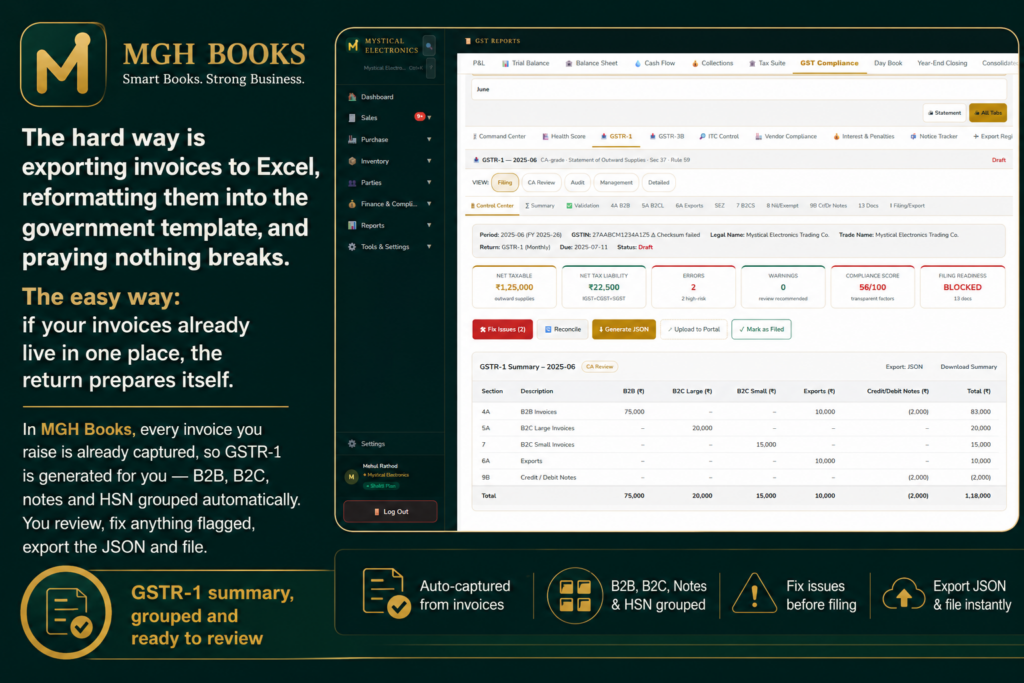
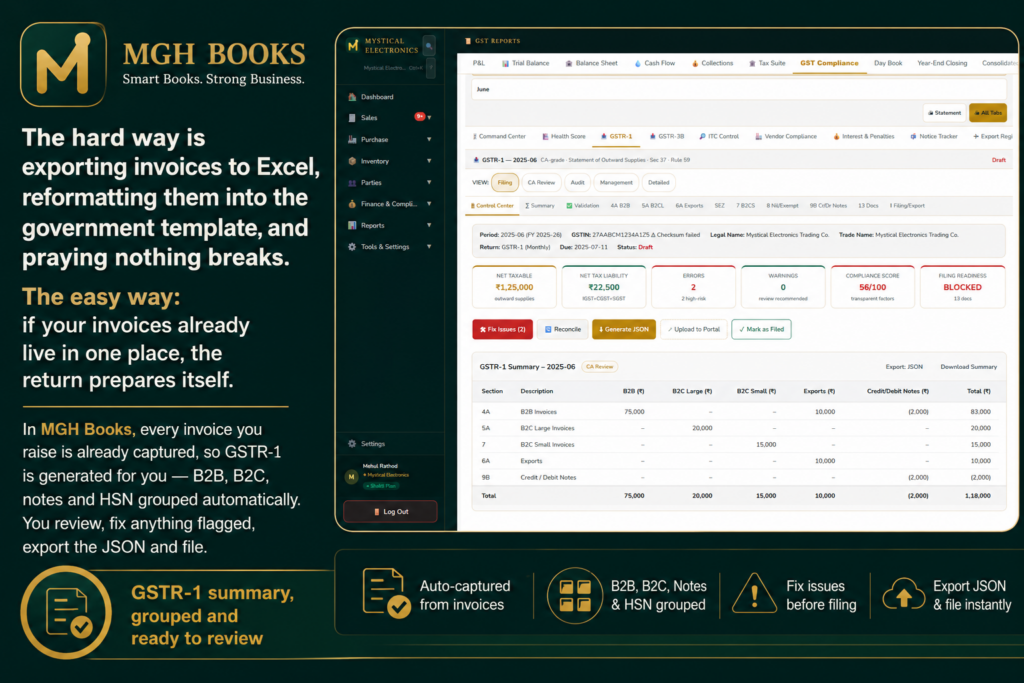
In today’s digital age, manual bookkeeping and compliance are not just inefficient but also risky. Modern GST accounting software like MGH Books is specifically designed to eliminate the common causes of late filing and ensure seamless compliance. MGH Books offers a connected platform that does the work of six, built for how Indian businesses actually run. Here’s how MGH Books helps you stay ahead of GST penalties:- Automated GST Return Preparation: MGH Books automatically prepares GSTR-1, GSTR-3B, HSN summaries, and GST JSON exports directly from your daily transactions. This eliminates manual data entry, reduces errors, and significantly speeds up the filing process. Data entry is dead, letting you focus on your business.
- Timely Alerts and Reminders: The platform provides intelligent, AI-powered insights and reminders for upcoming GST due dates, ensuring you never miss a deadline. These proactive alerts give you ample time to review and file your returns.
- CA-Ready Reports: MGH Books generates comprehensive, CA-grade reports such as Profit & Loss, Balance Sheet, Cash Flow, and Trial Balance. This means your Chartered Accountant has all the necessary information readily available, reducing the time spent on reconciliation and speeding up the final review and filing.
- Offline Functionality: Built for Indian businesses, MGH Books works fully offline. This is a game-changer for businesses in areas with intermittent internet connectivity, ensuring that your work continues uninterrupted and you can prepare returns even without an active internet connection, uploading them when available.
- Multi-Lingual Support: With support for 10 Indian languages, MGH Books makes it easier for businesses across diverse linguistic backgrounds to manage their finances and compliance effectively.
- Integrated Platform: Beyond just GST, MGH Books integrates accounting, inventory, manufacturing, payroll, compliance, and CRM into one system. This holistic approach ensures that all financial data is synchronized, reducing discrepancies that could lead to filing errors or delays.
- AI-Powered Insights: AI capabilities within MGH Books can flag potential issues, identify trends, and provide actionable insights, helping you make smarter business decisions and proactively address compliance risks before they become problems.
Best Practices for Timely Data Management
Technology is only as good as the data fed into it. Implementing robust data management practices is equally crucial:- Daily Transaction Recording: Don’t let transactions pile up. Record sales, purchases, expenses, and payments daily or at least weekly. This ensures data accuracy and reduces last-minute rush errors.
- Regular Reconciliation: Reconcile your bank statements, purchase registers, and sales registers regularly. MGH Books can automate much of this, but periodic human review is still valuable.
- Proper HSN/SAC Codes: Ensure correct HSN (Harmonized System of Nomenclature) or SAC (Service Accounting Code) codes are used for all goods and services. Incorrect codes can lead to mismatches and notices.
- Maintain Proper Documentation: Keep all invoices, debit notes, credit notes, and other relevant documents organized and accessible. This is vital for audits or clarification requests.
- Segregation of Duties: Clearly define roles and responsibilities within your finance team to avoid confusion and ensure accountability for data entry and review.
The Role of Professional Guidance (CAs and Accountants)
While software automates processes, the strategic oversight of a Chartered Accountant or a qualified accountant remains invaluable.- Expert Interpretation: CAs can interpret complex GST laws, notifications, and circulars, providing clarity on specific business scenarios.
- Audit and Review: They can perform periodic audits of your books and GST filings, identifying potential errors or non-compliance issues before they escalate.
- Representation: In case of notices, audits, or disputes with GST authorities, CAs can represent your business effectively.
- Strategic Advice: Beyond compliance, CAs can offer strategic advice on tax planning, optimizing ITC, and structuring transactions to be GST-compliant.
What Happens After Repeated Delays? Beyond Standard GST Penalties
While late filing fees and interest are the immediate consequences of delayed GST returns, repeated or prolonged non-compliance can lead to more severe actions from the GST authorities. Understanding these escalated risks is crucial for business owners, accountants, and CAs to appreciate the full spectrum of GST penalties India.Demand Notices and Adjudication Proceedings
If a taxpayer consistently fails to file returns or pay taxes, the GST department will issue demand notices.- GSTR-3A (Notice to return defaulter): If a registered person fails to furnish the return under section 39 (GSTR-3B), a notice in GSTR-3A may be issued requiring him to furnish the return within 15 days.
- Best Judgment Assessment (Section 62): If the registered person still fails to furnish the return after receiving the GSTR-3A notice, the proper officer may proceed to assess the tax liability
Excited to Know More